Case study · Web app & PWA
Kivo: a digital address for Lomé's street vendors
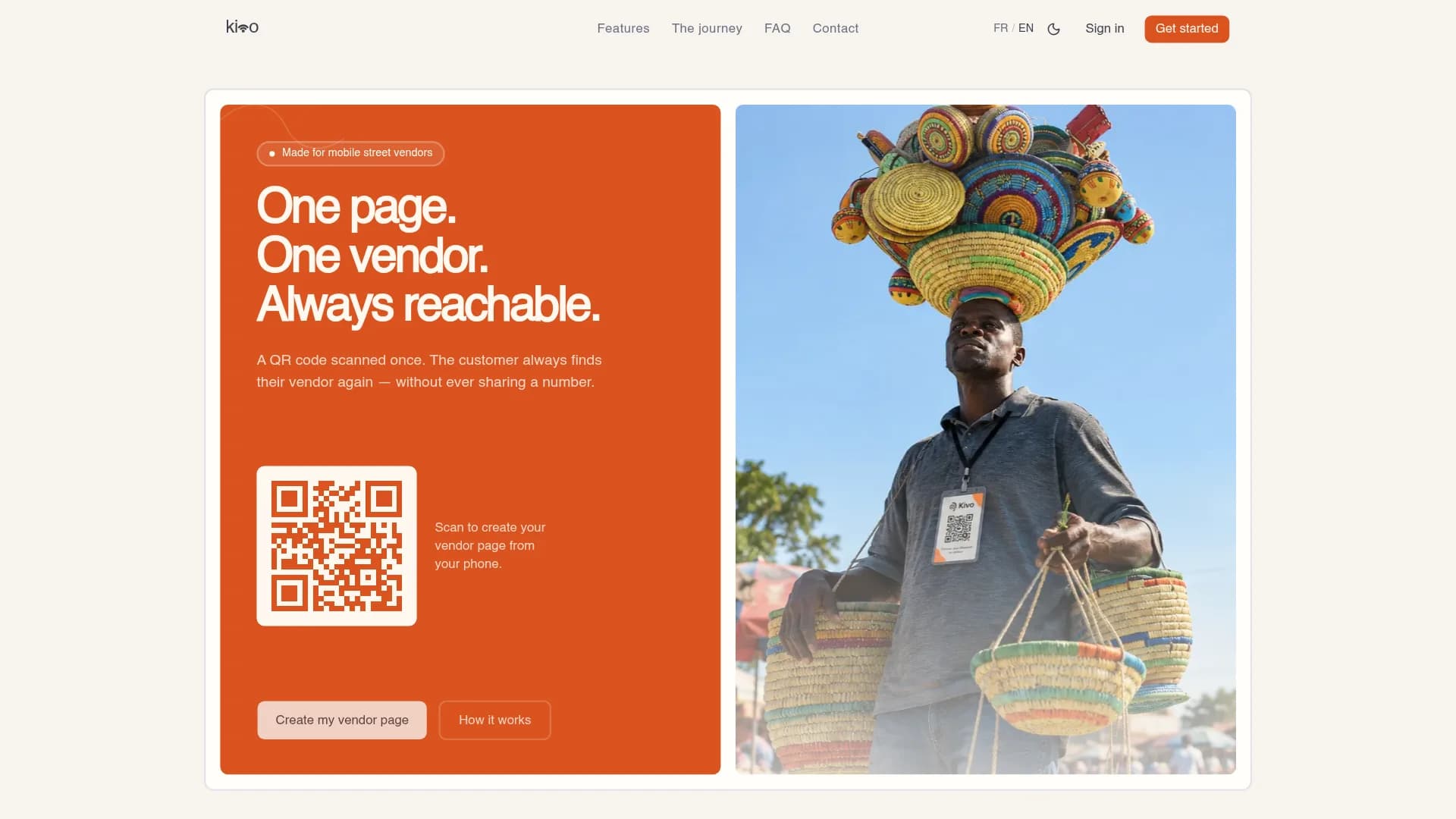
Kivo gives every mobile vendor a permanent page behind a QR code: today's selling zone, the next stop, and a follow button for customers. I designed, built and shipped it on my own, from the first commit on 10 September 2026 to the public launch on 16 October 2026 at kivo-africa.com.
- Role
- Design, backend, frontends, deployment (solo project)
- Timeline
- 10 Sep → 16 Oct 2026 (launch)
- Scope
- API + public PWA + admin back-office
- Quality
- 600+ Pest tests, 500+ commits
The problem
In Lomé, many traders sell on the move: a market in the morning, a crossroads in the afternoon, another neighbourhood the next day. They have no fixed address and no business listing, and regular customers lose track of them as soon as they change zones.
The usual workaround, sharing a personal WhatsApp number, quickly becomes intrusive for the vendor and unmanageable as the customer base grows. Every move costs sales.
The solution
The idea fits in one line: "The QR doesn't move. You do." Each vendor gets a unique, permanent QR code to print on a badge, a basket or a cart. It always leads to the same public page, which the vendor updates from their phone.
- Publish today's zone in two taps from a smartphone
- A public vendor page readable at a glance: today's zone and next stop
- Customers follow a vendor without exchanging phone numbers
- Real-time alerts to followers over WebSockets (Laravel Reverb) and Web Push
- Passwordless sign-in (email code or Google), bilingual FR/EN interface, installable as a PWA
- A separate back-office for staff: vendors, zones, roles and permissions, statistics
Architecture
Kivo is split into three applications that talk through a versioned API (/api/v1) with a single response envelope, { success, message, data }:
- A Laravel 13 / PHP 8.4 API with Sanctum (access and refresh token pairs), PostgreSQL in production
- A Next.js 16 / React 19 public app: marketing site, the vendor page behind each QR code, the vendor dashboard and customer follows
- A separate Next.js back-office, admin accounts only, with no public surface at all
Technical choices
The backend follows a strict Controller → Service → Repository architecture: controllers validate and delegate in one line, services hold the business logic, and repositories are the only layer that talks to Eloquent. Every new resource was generated with laravel-make-pattern, my own open-source package, which kept the modules consistent from the first day to the last.
OpenAPI docs are generated from the code (Scramble), roles rely on spatie/laravel-permission, and the test suite runs on in-memory SQLite to stay fast.
The hardest problem: SMS fraud
Sign-in by SMS code is the most natural option for vendors, but every SMS costs money. A poorly protected OTP endpoint can be "pumped" by bots that trigger thousands of messages to premium-rate numbers.
I added dual-key rate limiting (per IP and per targeted identifier, so a bot can't get around it by changing only one of them), a cap of 5 SMS per number per day, and dedicated limits on anonymous public writes such as QR scans and follows. Automated tests cover these rules.
Going live
Kivo is self-hosted and deployed with Coolify: every commit on each repository's main branch goes to production. The goal was a near-zero-cost launch until real traffic arrives, with a path to paid tiers that needs no rewrite once concrete thresholds are reached. Files live on MinIO (S3-compatible), email goes through Resend, real-time runs on Reverb.